
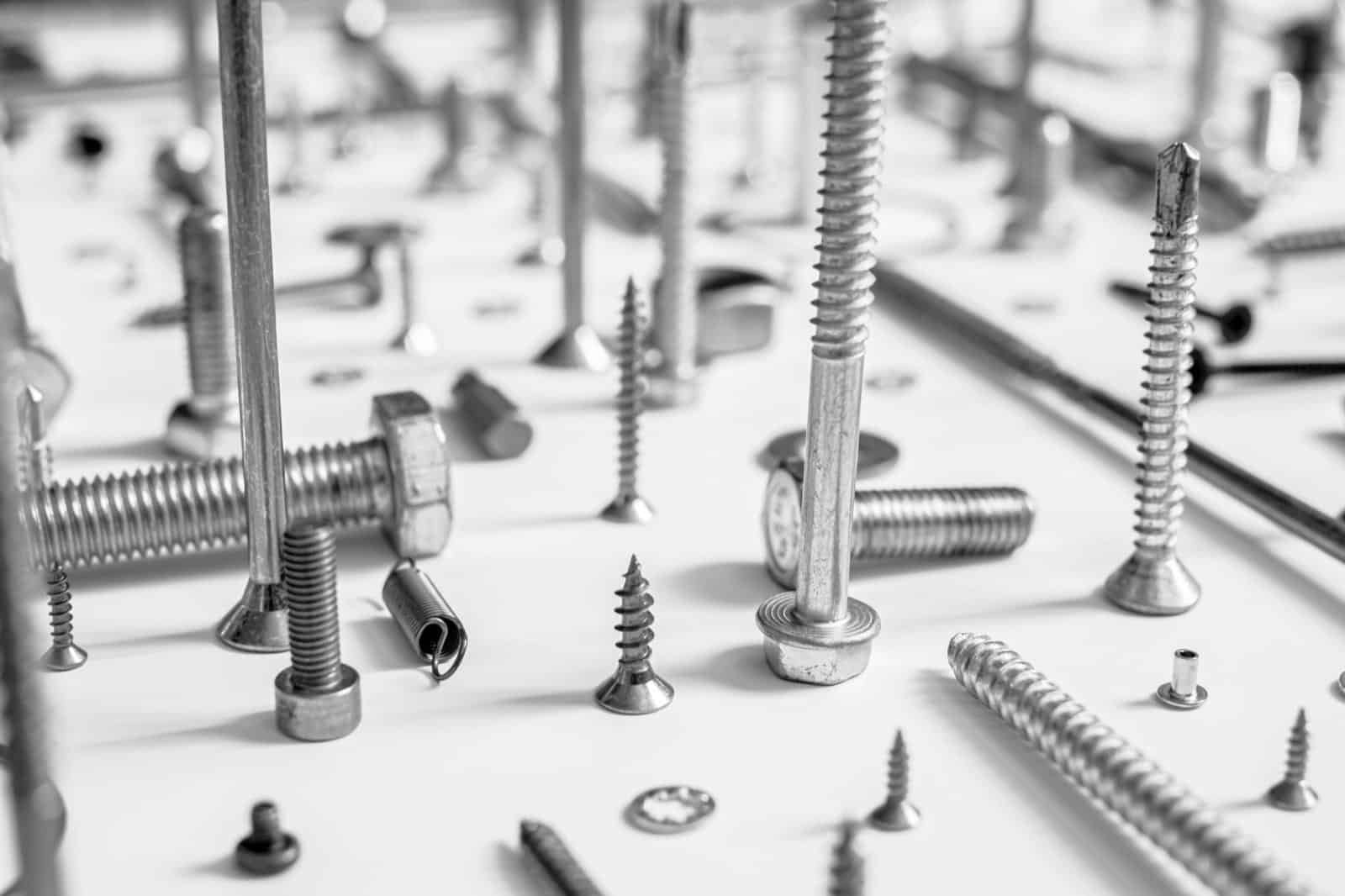
Fixings are the cheapest component on a steel roof and the one most likely to cause a callback. A sheet is a simple thing that sheds water reliably. Every fixing is a deliberate hole punched through it, and each one is only as good as the washer, the placement and the person holding the driver.
The two jobs fixings do
Primary fixings attach the sheet to the structure — the purlins or rails underneath. These carry the load: the weight of the sheet, wind uplift, snow, and anyone walking on the roof.
Stitching fixings join sheet to sheet at the side laps. They do not reach the structure. Their job is to hold the lap closed so wind cannot drive water up between two sheets, and to make the two sheets behave as one under load.
Leaving out stitchers is a common economy on smaller jobs, and side laps opening up in wind is the predictable result.
Crown or valley?
This one still generates argument on site. Fixing through the crown, the top of the rib, keeps the fixing out of the water path. Fixing through the valley, the flat between ribs, pulls the sheet tight to the purlin and gives a stiffer connection.
The important thing is that both approaches work when done properly and both leak when done badly, and the decision should follow the profile manufacturer’s recommendation rather than habit. What matters far more is the washer and the torque.
Washers, and why they matter more than the screw
The seal is made by the washer, not the thread. A bonded EPDM washer compresses to form a gasket around the hole. Get the compression right and it stays sealed for the life of the roof. Get it wrong and you have a hole with a screw in it.
Two failure modes, both common:
- Undertightened — the washer never fully compresses, so the seal is incomplete from day one
- Overtightened — the washer is crushed and extruded out from under the head, so there is nothing left to seal with, and the sheet is often dimpled around the fixing as well
The visual check is straightforward: the washer should be visibly compressed and just proud of the screw head all the way round. If it has spread out into a flange, it is too tight.
A driver with an adjustable depth stop pays for itself on the first roof, because it takes the judgement out of the hands of whoever is tired at four o’clock.
Placement: the edges are not like the middle
Wind uplift is not uniform across a roof. It concentrates at the perimeter — the eaves, the verges and the ridge — and at corners most of all. Fixing patterns should reflect that, with denser fixing in the perimeter zones and standard centres in the field.
Fixing the whole roof at field centres and hoping is one of the more common causes of sheets lifting on exposed sites. It is also entirely avoidable at the specification stage.
Getting the length right
The fixing has to pass through the sheet, through any insulation or spacer, and achieve proper engagement in the purlin. On a twin-skin or insulated build-up that means a considerably longer fixing than a single-skin roof, and using a single length across a building with varying build-ups is a mistake that shows up as fixings that spin without gripping.
Count the layers, then add the engagement depth. Do not eyeball it.
Compatibility
Mixing metals invites galvanic corrosion, and the wrong fixing on an aluminium or coated sheet will corrode at the head long before the sheet does. Our roof fixings are supplied to suit the sheets we manufacture, which removes the guesswork.
The mistakes worth writing down
- Overtightening, and crushing the washer
- Omitting stitching fixings at side laps
- Uniform fixing centres across the whole roof, ignoring perimeter uplift
- One fixing length used across different build-ups
- Reusing holes when replacing a sheet, rather than fixing into fresh material
None of these cost anything to avoid. All of them cost something to put right at height.
Ordering
Fixings are easy to under-order, because the perimeter zones need more than the average suggests. If you are pricing a job with our roofing calculator, the fixings can go on the same order as the sheets. If you are unsure what suits your build-up, ask us before the sheets arrive rather than after.