

Every profiled roof sheet has a minimum pitch, and it is one of the specifications people most often try to argue with. The number is not arbitrary and it is not a manufacturer being cautious. It comes from how water behaves on a sloping metal surface, and from what happens at the joints.
Why a minimum exists at all
Water running down a roof does not travel in a neat sheet. It slows at obstructions, spreads sideways, and on a shallow slope it moves slowly enough for wind to push it in directions it would not otherwise go — including uphill.
Two things then matter. First, whether the water clears the roof before it finds a joint. Second, whether the joints are detailed to cope with water arriving under pressure rather than simply running past.
Below a certain pitch, water sits long enough to be driven into laps, and the roof leaks in wind-driven rain despite being perfectly sound in still conditions.
What changes the number
Sheet length
The single biggest factor, and the one most often overlooked. A long slope collects more water toward the bottom, so the volume crossing the lowest metre of sheet is far greater than at the ridge. Longer runs generally need more pitch, not less.
This cuts both ways usefully: because our sheets are cut to length, a slope that can be covered in one piece has no end laps at all, which removes the most vulnerable joint on a shallow roof. It is often worth checking whether a single-piece run is possible before accepting a lower pitch with laps in it.
End laps
Where two sheets overlap down the slope, you have a joint facing the water flow. On shallower pitches these need to be longer, and often sealed, rather than simply overlapped. Every end lap you can design out is a leak path you no longer have to detail.
Profile depth
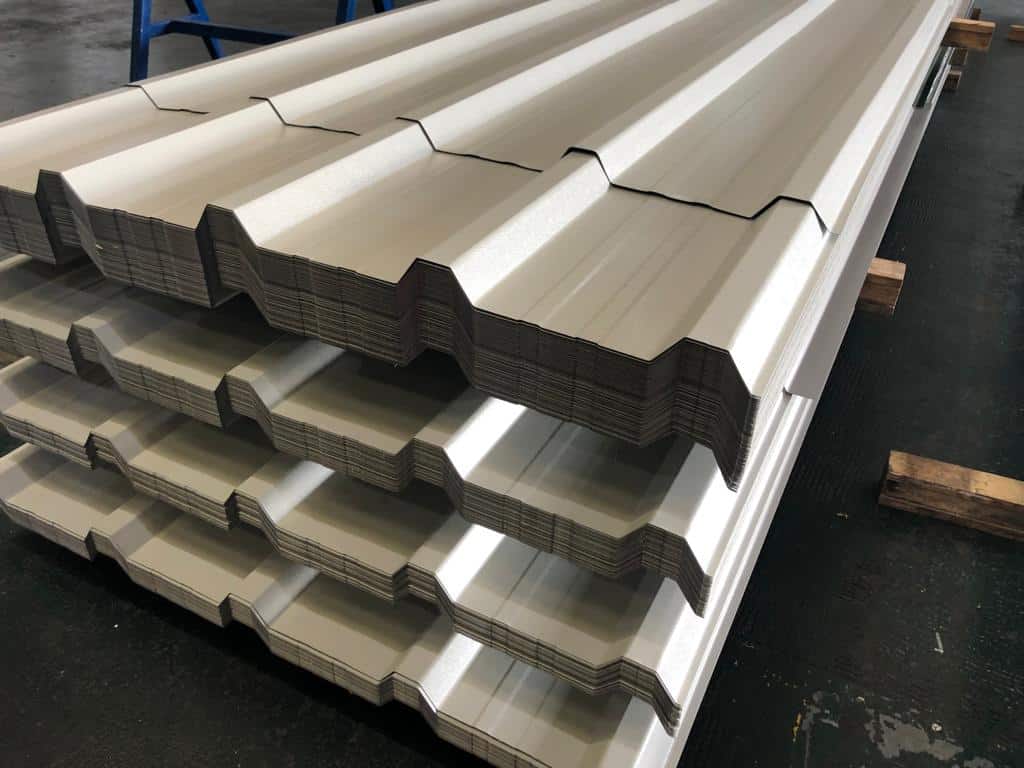
A deeper profile gives water a defined channel and more freeboard before it can spill over a rib into the lap. This is part of why box profile generally copes with shallower pitches than corrugated sheeting.
Exposure
A sheltered building in a valley and an exposed building on a ridge are not the same problem. Wind drives rain up the slope, and the more exposed the site the more pitch you want for the same detail. Coastal and hilltop sites deserve a margin.
Measuring the pitch you actually have
Pitch is expressed either in degrees or as a ratio of rise to run. Both describe the same thing and either is fine, as long as everyone on the job is using the same one — mixing a ratio for one elevation and degrees for another is a reliable route to a mistake.
On an existing building, measure it rather than trusting the drawing. Frames settle, and roofs that were built to a nominal pitch are often a degree or two off it decades later. A degree matters when you are near the limit.
If your pitch is below the minimum
You have real options, and none of them is ignoring it:
- Remove the end laps by running full-length sheets, where the structure and access allow
- Increase and seal the laps where full-length sheets are not practical
- Change profile to something with more depth
- Alter the structure to gain pitch, which is the expensive answer but sometimes the right one
- Use a system designed for low pitch, such as a standing seam approach, rather than forcing a profiled sheet below its limit
What does not work is fitting a sheet below its minimum pitch and relying on sealant. Sealant is a supplement to a sound detail, never a substitute for one, and it has a much shorter life than the roof.
Flat and near-flat roofs
A genuinely flat roof is a different discipline and profiled steel sheeting is not the answer. Where you need flat metalwork for flashings, trims and fabrication, our flat metal sheets are cut to size, but that is a component rather than a roofing system.
Checking your specification
If you know your pitch and your slope length, our roofing calculator will help you put a specification together. If you are close to a limit, or working on an existing building where the pitch is not quite what the drawing claims, give us a call and we will work through it with you. Getting this right before the sheets are rolled is considerably cheaper than afterwards.